
內庭 (Nèitíng) — Inner Court
Stomach channel · point 44
Traditionally used for
- Nose & throat
- Teeth & mouth
- Colds & fever
- Digestion
- Bowel health
- Mood & calm
Location
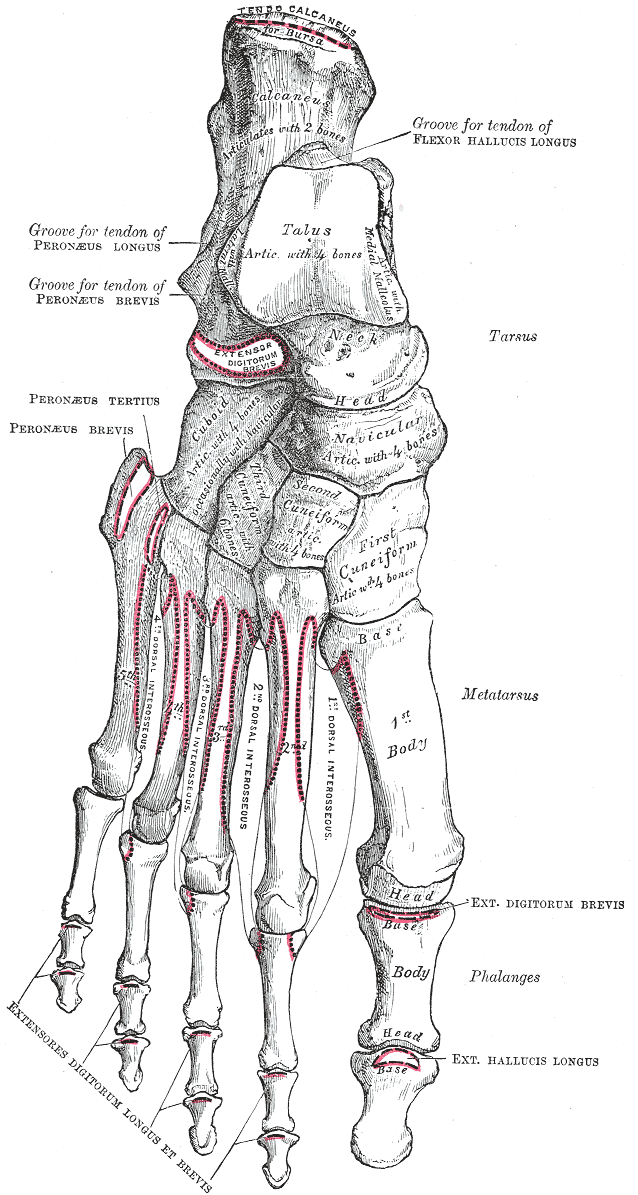
On the dorsum of the foot, between the second and third toes, just proximal to the web margin, at the border between red and white flesh.
How to locate: Just proximal to the web margin between the second and third toes, on the border where the skin of the sole meets the skin of the dorsum.
Regional anatomy: Vessels: the dorsal venous network of foot. Nerves: just where the lateral branch of the medial dorsal cutaneous nerve divides into dorsal digital nerves.
Distances are in cun, a proportional unit — how to measure.
Needling
Cited needling
Techniques — the source gives these as alternatives:
-
Perpendicular insertionDepth 0.5–0.5 cunskindeeper
-
Oblique insertion — directed proximallyDepth 0.5–1 cunskindeeper
Second source — Beijing College of Traditional Chinese Medicine, et al 1980, p. 143:
-
Perpendicular insertionDepth 0.3–0.5 in (≈8–13 mm)skindeeper
Depths describe average adult habitus in the cited population, never a single safe number for the patient in front of you. Palpate and adjust.
Sources (2)
- Deadman P, Al-Khafaji M, Baker K. A Manual of Acupuncture. Hove: Journal of Chinese Medicine Publications; 1998 — p. 171 Supports: techniques (names this point)
- Beijing College of Traditional Chinese Medicine, et al. Essentials of Chinese Acupuncture. Beijing: Foreign Languages Press; 1980 — p. 143 Supports: techniques (names this point)
Site notes · not cited
Functions
- Clears heat from the Stomach channel and from the Stomach itself
- Expels wind and relieves pain of the face and teeth
- Regulates the intestines and clears damp-heat
- Calms the spirit
Indications
Balance Method partners
Under Dr. Tan's six systems, ST44 at the foot balances these channels at the regions its segment images.
-
1. Same Chinese nameLarge Intestine channelHand · Mirror (arm ↔ leg)Head & face, Crown & occiput, Ear · Image, head at the hand/footSolve for the Large Intestine channel →
-
2. Branching (Bie Jing / Zang Fu Bie Tong)Pericardium channelHand · Mirror (arm ↔ leg)Head & face, Crown & occiput, Ear · Image, head at the hand/footSolve for the Pericardium channel →
-
3. Interior–exterior pairSpleen channelFoot · Same segment, opposite sideHead & face, Crown & occiput, Ear · Image, head at the hand/footSolve for the Spleen channel →
-
4. Chinese clock oppositePericardium channelHand · Mirror (arm ↔ leg)Head & face, Crown & occiput, Ear · Image, head at the hand/footSolve for the Pericardium channel →
-
5. Chinese clock neighbourLarge Intestine channelHand · Mirror (arm ↔ leg)Head & face, Crown & occiput, Ear · Image, head at the hand/footSolve for the Large Intestine channel →
-
6. Same channelStomach channelFoot · Same segment, opposite sideHead & face, Crown & occiput, Ear · Image, head at the hand/footSolve for the Stomach channel →
Classical calendar method · 子午流注
When the tables open ST44
The hours Zi Wu Liu Zhu names this point at, by method. Times are the double-hour's start in America/New_York.
-
戊戌 19:00–21:00 Na Jia Fa, 丙-day sequence · Ying-Spring (滎)
「戊戌內庭治脹康」
Next: Sat 28 Nov, 19:00
A classical reference, not a recommendation: the tables say when the method opens this point, not that it is the point to needle. Open points by the hour →
Clinical Notes
Combinations Using This Point
Toothache — wind-heat
LI4, ST44, ST7, ST6 and GB20, reduced, to clear heat and stop toothache from wind-heat.
Sore throat — shi type
LU11 bled with LI4, ST44 and SI17, reduced, to expel wind-heat and clear lung and stomach heat in an acute sore throat.
Trigeminal neuralgia — mandibular branch
ST7, ST6 and CV24 over the jaw with ST44 distally for pain in the third (mandibular) division of the trigeminal nerve.
Headache — frontal
ST8, Yintang and GV23 locally with LI4 and ST44 distally for forehead and brow pain on the Yangming channels.
Similar Points
Ranked by shared patterns and conditions
Sources
- World Health Organization. WHO Standard Acupuncture Point Locations in the Western Pacific Region. Manila: WHO Regional Office for the Western Pacific, 2008. (Location.)
- Focks C, ed. Atlas of Acupuncture. Edinburgh: Churchill Livingstone Elsevier, 2008. (Locating method and actions.)
- Beijing College of Traditional Chinese Medicine, Shanghai College of Traditional Chinese Medicine, Nanjing College of Traditional Chinese Medicine, Acupuncture Institute of the Academy of Traditional Chinese Medicine. Essentials of Chinese Acupuncture. Beijing: Foreign Languages Press, 1980. (Regional anatomy.)
Professional contributions
Clinical notes and case studies from verified practitioners, reviewed by our team before they appear. Each entry is one practitioner's report — not editorial content, and not a dosing reference.
No professional contributions yet.
Verified professionals with a live directory listing can share clinical notes and case studies here.
📝 Notes
Public notes from the community and your own private notes on ST44 Neiting.
No notes yet.