
大椎 (Dàzhuī) — Great Hammer
Du (Governing) channel · point 14
Traditionally used for
- Cough & breathing
- Colds & fever
- Nerves & recovery
- Pain & joints
- Skin
Cautions & contraindications
- No deep needling
Location
On the posterior midline, in the depression below the spinous process of C7.
How to locate: With the patient seated, rest fingers on the two most prominent spinous processes at the base of the neck and have the patient tilt the head back: C6 glides forwards while C7 stays fixed. (Rotating the head with the neck slightly flexed, C7 can also be felt to turn while T1 does not.) The point is in the depression below C7.
Regional anatomy: Beneath the skin and subcutaneous tissue the needle passes through the supraspinous and interspinous ligaments toward the ligamentum flavum; the spinal canal and cord lie beyond it.
Distances are in cun, a proportional unit — how to measure.
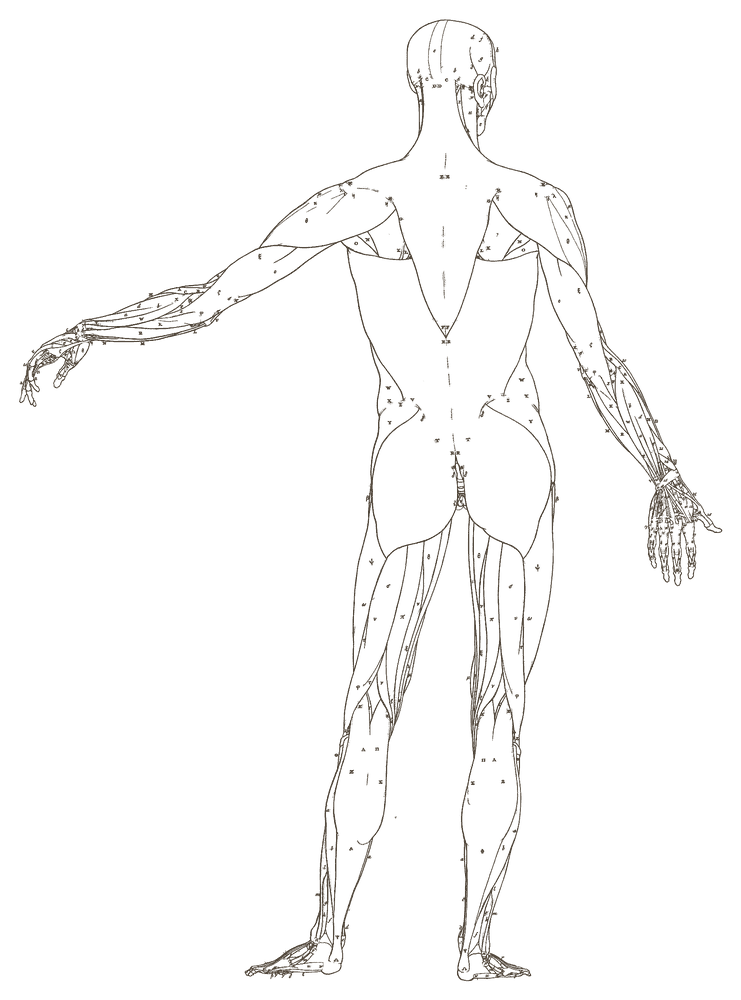
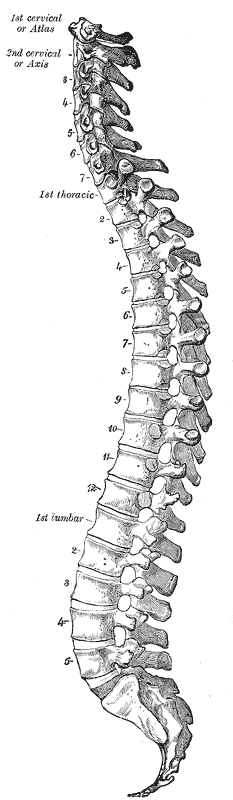 Needling hazard — see Needling safety
Needling
Cited needling
- ⚠ Spinal cord / medulla
-
Perpendicular-oblique insertion — superiorDepth 0.5–1 cunskindeeper
| Underweight | Normal | Overweight | |
|---|---|---|---|
| Men | 48.1 | 53.9 | 67.6 |
| Women | 43.5 | 52.1 | 63.7 |
CT-measured mean safe needling depths from Taiwanese adults, by sex and body size (Lin et al. 2013); population-specific and a guide only — adjust to the patient in front of you. Case reports: central nervous system injury after needling at this point (1 case in Wu et al. 2015).
Depths describe average adult habitus in the cited population, never a single safe number for the patient in front of you. Palpate and adjust.
Sources (4)
- Lin JG, Chou PC, Chu HY. An exploration of the needling depth in acupuncture: the safe needling depth and the needling depth of clinical efficacy. Evid Based Complement Alternat Med. 2013;2013:740508 — Tables 9 (male) and 10 (female), back acupoints Supports: safe depth (measured)
- World Health Organization. Guidelines on basic training and safety in acupuncture. Geneva: WHO; 1999. WHO/EDM/TRM/99.1 — Section II §5.2 (Central nervous system), p. 25 Supports: spinal cord / medulla (names this region)
- Wu J, Hu Y, Zhu Y, Yin P, Litscher G, Xu S. Systematic review of adverse effects: a further step towards modernization of acupuncture in China. Evid Based Complement Alternat Med. 2015;2015:432467 — Table 2 (Central nervous system injury associated with acupuncture) Supports: spinal cord / medulla (case report)
- Deadman P, Al-Khafaji M, Baker K. A Manual of Acupuncture. Hove: Journal of Chinese Medicine Publications; 1998 — p. 545 Supports: techniques (names this point)
Site notes · not cited
- No deep needling
Functions
- Clears heat and releases the exterior
- Regulates the defensive qi and strengthens immunity
- Clears the mind and settles convulsions
- Tonifies qi and yang in deficiency
- Regulates the Du Mai and benefits the neck
Indications
Clinical Notes
Combinations Using This Point
Dazhui, Fengmen and Feishu
GV14, BL12 and BL13 across the upper back — expels wind, firms the exterior and restores the Lung's dispersing and descending.
Fengchi, Tianzhu and Dazhui
Fengchi, Tianzhu and Dazhui across the nape — a combination for wind invasion with headache and fever, stiff neck, cough and convulsions.
Sources
- World Health Organization. WHO Standard Acupuncture Point Locations in the Western Pacific Region. Manila: WHO Regional Office for the Western Pacific, 2008. (Location.)
- Focks C, ed. Atlas of Acupuncture. Edinburgh: Churchill Livingstone Elsevier, 2008. (Locating method and actions.)
📝 Notes
Public notes from the community and your own private notes on GV14 Dazhui.
No notes yet.