
天樞 (Tiānshū) — Celestial Pivot
Stomach channel · point 25
Traditionally used for
- Digestion
- Bowel health
- Urinary & fluids
- Menstrual & women's health
Cautions & contraindications
- Pregnancy
Location
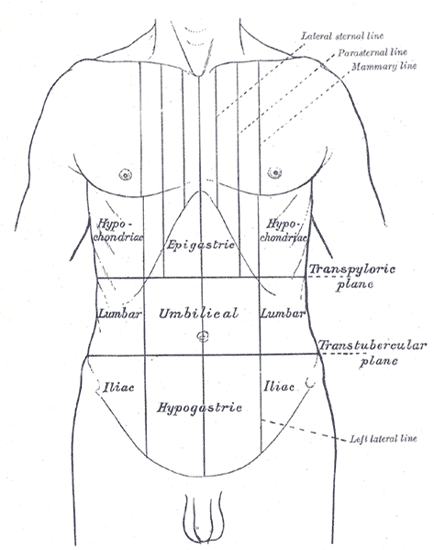
On the abdomen, 2 cun lateral to the centre of the umbilicus.
How to locate: With the patient supine, measure 2 cun laterally from the centre of the umbilicus, halfway to the line of the nipple (4 cun from the midline); the point usually falls over the belly of rectus abdominis.
Regional anatomy: Beneath the skin and subcutaneous tissue the needle passes through the anterior rectus sheath, rectus abdominis and the posterior rectus sheath; the peritoneum and small intestine lie beyond.
Distances are in cun, a proportional unit — how to measure.
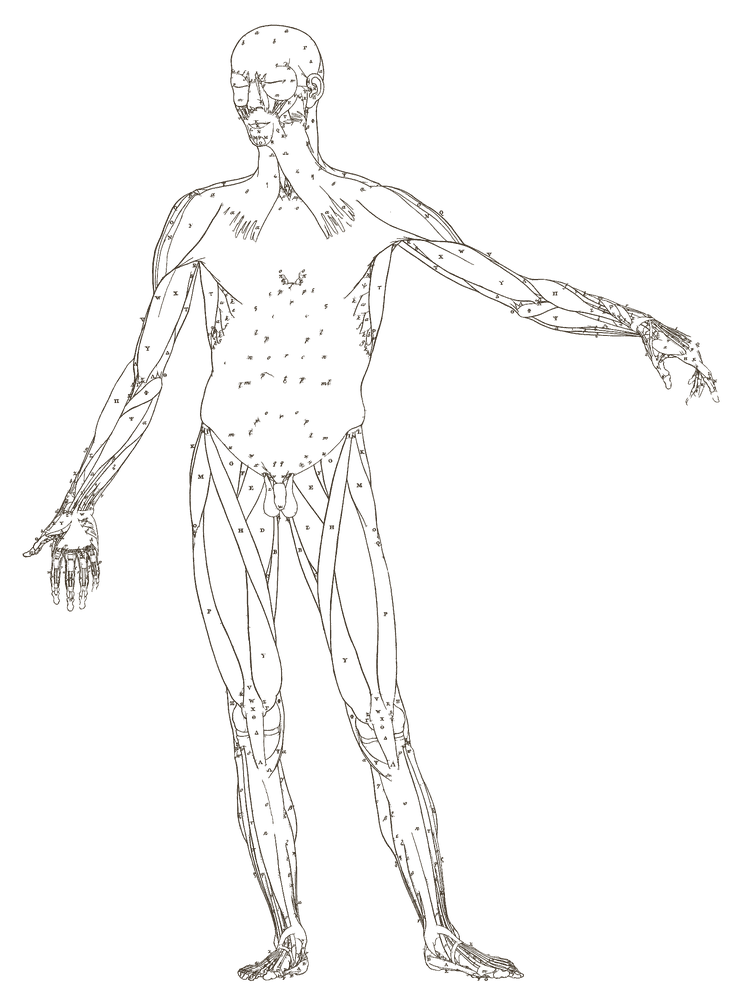
3D view
The 3D view is not available on this device. The 2D maps above show the same point.
Drag, or focus the model and use the arrow keys, to rotate; + and − to zoom; 0 to reset; Esc to close.
Needle diagram for the marked point — a schematic section through the skin, not the model.
3D anatomy: BodyParts3D, © The Database Center for Life Science licensed under CC Attribution 4.0 International (licence). Subset, simplified and recoloured by Verscienta — changes and licence details.
Approximate placement, carried over from our 2D body map onto a single adult male model (BodyParts3D) and checked against the point's location text. Shown on one side of the body. Locate the point on your patient by the location text and palpation, not by this model.
- Cun on this part of the body
- From the midpoint of the xiphisternal synchondrosis to the centre of the umbilicus: 8 B-cun (WHO 2008, General Guidelines, Proportional Bone (Skeletal) Measurements, p. 12).
- Needle angle and depth
-
- Perpendicular (90° to the skin), 1–1.5 cun. Deadman P, Al-Khafaji M, Baker K, p. 148
- Oblique, inferior, towards the uterus for diseases of the uterus — not drawn: no cited depth in cun.
3D anatomy: BodyParts3D, © The Database Center for Life Science licensed under CC Attribution 4.0 International (licence). Subset, simplified and recoloured by Verscienta — changes and licence details.
Needling
Cited needling
Techniques — the source gives these as alternatives:
-
Perpendicular insertionDepth 1–1.5 cunskindeeper
-
Oblique insertion — inferior, towards the uterus for diseases of the uterus
Second source — Beijing College of Traditional Chinese Medicine, et al 1980, p. 134:
-
Perpendicular insertionDepth 0.7–1.2 in (≈18–30 mm)skindeeper
Depths describe average adult habitus in the cited population, never a single safe number for the patient in front of you. Palpate and adjust.
Sources (2)
- Deadman P, Al-Khafaji M, Baker K. A Manual of Acupuncture. Hove: Journal of Chinese Medicine Publications; 1998 — p. 148 Supports: techniques (names this point)
- Beijing College of Traditional Chinese Medicine, et al. Essentials of Chinese Acupuncture. Beijing: Foreign Languages Press; 1980 — p. 134 Supports: techniques (names this point)
Site notes · not cited
- Pregnancy
Functions
- Regulates the Spleen, Stomach and intestines and resolves stagnation
- Resolves dampness and clears damp-heat from the intestines
- Regulates qi and blood in the lower burner
- Regulates menstruation
Indications
Clinical Notes
Combinations Using This Point
Tianshu and Shangjuxu
ST25 and ST37, the Front-Mu and lower He-Sea points of the Large Intestine — for diarrhoea, constipation, distension and acute abdominal conditions.
Diarrhoea
ST25, BL25 and ST36: the Front-Mu and Back-Shu of the Large Intestine with ST36, the base prescription for acute and chronic diarrhoea.
Dysentery
ST25, ST37 and LI4 for dysentery: the Front-Mu and Lower He-Sea of the Large Intestine with LI4 to clear stagnation in the intestines.
Guanyuan and Tianshu
CV4 with ST25 — warms the middle burner, harmonises the Stomach and regulates the intestines in bowel and digestive complaints.
Infantile diarrhoea
CV12, ST25, ST37 and Sifeng with even needling, unretained, to restore the spleen and stomach in infant diarrhoea.
Abdominal pain — around the umbilicus
KI5 with CV6 and ST25 for abdominal pain around the navel, the area the book assigns to the kidney.
Appendicitis
Lanweixue or ST37 with LI11 and ST25, reduced with long retention, for acute simple appendicitis.
Amenorrhoea — blood exhaustion
CV4, BL18, BL20, BL23, ST25, ST36 and SP6, reinforced with moxa, to rebuild blood when menstruation has dried up.
Similar Points
Ranked by shared patterns and conditions
Sources
- World Health Organization. WHO Standard Acupuncture Point Locations in the Western Pacific Region. Manila: WHO Regional Office for the Western Pacific, 2008. (Location.)
- Focks C, ed. Atlas of Acupuncture. Edinburgh: Churchill Livingstone Elsevier, 2008. (Locating method and actions.)
Professional contributions
Clinical notes and case studies from verified practitioners, reviewed by our team before they appear. Each entry is one practitioner's report — not editorial content, and not a dosing reference.
No professional contributions yet.
Verified professionals with a live directory listing can share clinical notes and case studies here.
📝 Notes
Public notes from the community and your own private notes on ST25 Tianshu.
No notes yet.