
足三里 (Zúsānlǐ) — Leg Three Li
Stomach channel · point 36
Traditionally used for
- Dizziness
- Digestion
- Bowel health
- Sleep
- Mood & calm
- Pain & joints
- Heart & circulation
- Energy & fatigue
Location
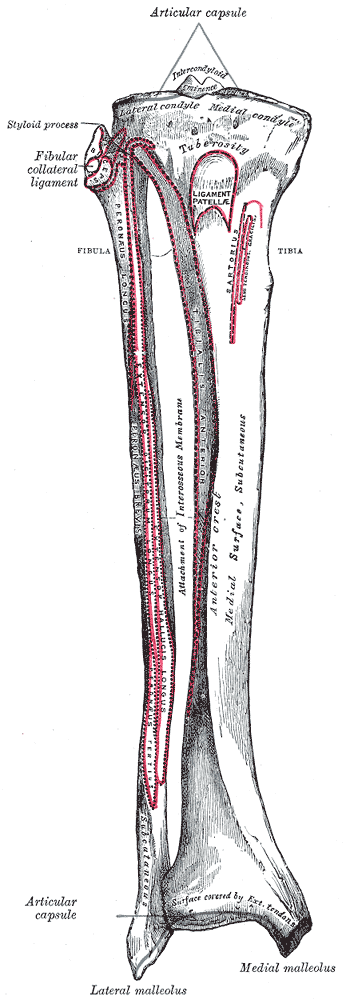
On the anterior lower leg, on the line connecting ST35 and ST41, 3 cun below ST35, over tibialis anterior (about one finger-breadth lateral to the anterior crest of the tibia).
How to locate: Find ST35 in the lateral hollow below the kneecap, measure one hand-breadth (3 cun) down and place the middle finger against the anterior crest of the tibia: the point is in the depression one finger-breadth lateral to the crest, often level with the lower border of the tibial tuberosity. Choose the most tender spot; cupping the palm over the kneecap puts the middle fingertip roughly on it.
Regional anatomy: Beneath the skin and subcutaneous tissue the needle enters tibialis anterior and continues toward the interosseous membrane; the anterior tibial artery and deep fibular nerve run deep to the point.
Distances are in cun, a proportional unit — how to measure.

3D view
3D view not available for this point: its position can't be carried onto the 3D model reliably (it failed a placement check). The 2D maps above show it.
Needling
Cited needling
-
Perpendicular insertionDepth 1–1.5 cunskindeeper
Depths describe average adult habitus in the cited population, never a single safe number for the patient in front of you. Palpate and adjust.
Sources (1)
- Deadman P, Al-Khafaji M, Baker K. A Manual of Acupuncture. Hove: Journal of Chinese Medicine Publications; 1998 — p. 158 Supports: techniques (names this point)
Site notes · not cited
Functions
- Tonifies qi and yang, nourishes blood and yin and strengthens the whole body
- Harmonises the Stomach, strengthens the Spleen and resolves dampness
- Regulates the intestines
- Raises yang and restores collapse
- Calms the spirit
- Opens the channel
Indications
Balance Method partners
Under Dr. Tan's six systems, ST36 at the lower leg balances these channels at the regions its segment images.
-
1. Same Chinese nameLarge Intestine channelForearm · Mirror (arm ↔ leg)Upper arm · Reversed mirrorChest, Upper back · Image, head at the hand/footUpper abdomen, Lower back · Image, head toward the elbow/kneeSolve for the Large Intestine channel →
-
2. Branching (Bie Jing / Zang Fu Bie Tong)Pericardium channelForearm · Mirror (arm ↔ leg)Upper arm · Reversed mirrorChest, Upper back · Image, head at the hand/footUpper abdomen, Lower back · Image, head toward the elbow/kneeSolve for the Pericardium channel →
-
3. Interior–exterior pairSpleen channelLower leg, Calf · Same segment, opposite sideChest, Upper back · Image, head at the hand/footUpper abdomen, Lower back · Image, head toward the elbow/kneeSolve for the Spleen channel →
-
4. Chinese clock oppositePericardium channelForearm · Mirror (arm ↔ leg)Upper arm · Reversed mirrorChest, Upper back · Image, head at the hand/footUpper abdomen, Lower back · Image, head toward the elbow/kneeSolve for the Pericardium channel →
-
5. Chinese clock neighbourLarge Intestine channelForearm · Mirror (arm ↔ leg)Upper arm · Reversed mirrorChest, Upper back · Image, head at the hand/footUpper abdomen, Lower back · Image, head toward the elbow/kneeSolve for the Large Intestine channel →
-
6. Same channelStomach channelLower leg, Calf · Same segment, opposite sideChest, Upper back · Image, head at the hand/footUpper abdomen, Lower back · Image, head toward the elbow/kneeSolve for the Stomach channel →
Classical calendar method · 子午流注
When the tables open ST36
The hours Zi Wu Liu Zhu names this point at, by method. Times are the double-hour's start in UTC.
-
戊子 23:00–01:00 Na Jia Fa, 庚-day sequence · He-Sea (合)
「戊子時居三里宜」
Next: Tue 13 Oct, 23:00
A classical reference, not a recommendation: the tables say when the method opens this point, not that it is the point to needle. Open points by the hour →
Clinical Notes
Combinations Using This Point
Balance Method for Shoulder Pain
Anterior shoulder pain on the Large Intestine channel treated from the Stomach channel of the opposite leg, most often around ST38.
Yanglingquan and Zusanli
GB34 and ST36, He-Sea points below the knee — for digestive, hypochondriac and head complaints, cough, jaundice, enuresis and weak legs.
Miriam Lee's Ten Points
Five points needled bilaterally — LI4, LI11, ST36, SP6 and LU7 — as a single restorative prescription for the depleted, overworked patient.
Tonifying Moxibustion — CV4, CV6, ST36 and GV4
The four points that carry the classical reputation for building qi and yang — moxaed rather than needled.
Zhongwan, Neiguan and Zusanli
CV12, PC6 and ST36 — the Stomach's Mu point with forearm and leg distal points — for vomiting, abdominal pain and distension, and bowel disorders.
Similar Points
Ranked by shared patterns and conditions
Sources
- World Health Organization. WHO Standard Acupuncture Point Locations in the Western Pacific Region. Manila: WHO Regional Office for the Western Pacific, 2008. (Location.)
- Focks C, ed. Atlas of Acupuncture. Edinburgh: Churchill Livingstone Elsevier, 2008. (Locating method and actions.)
📝 Notes
Public notes from the community and your own private notes on ST36 Zusanli.
No notes yet.