
合谷 (Hégǔ) — Union Valley
Large Intestine channel · point 4
Traditionally used for
- Headaches
- Eye health
- Nose & throat
- Teeth & mouth
- Colds & fever
- Menstrual & women's health
- Nerves & recovery
Cautions & contraindications
- Pregnancy
Location
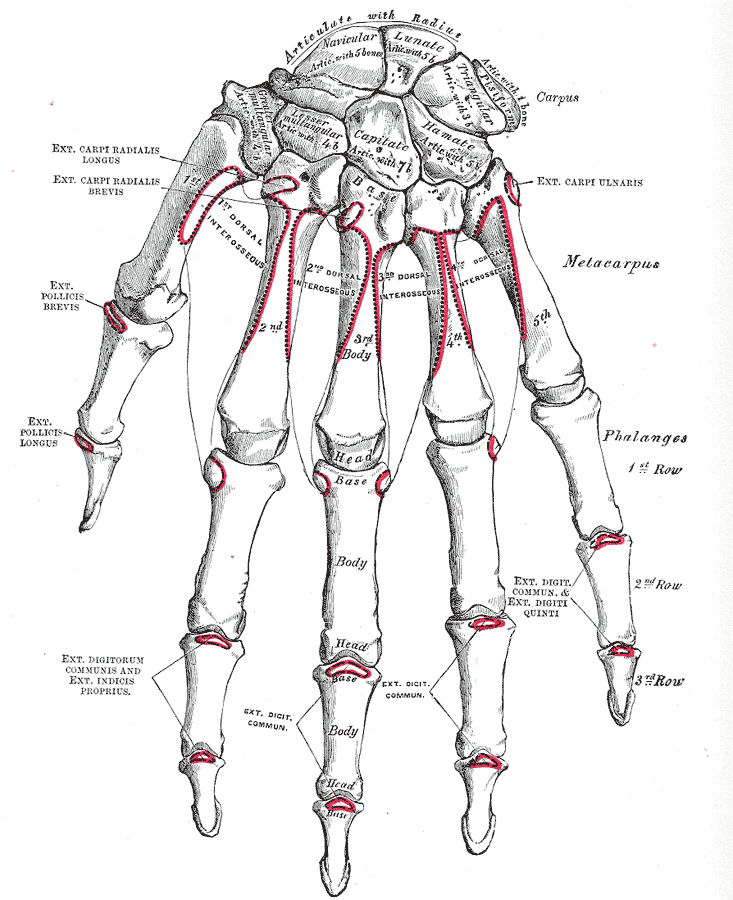
On the dorsum of the hand, between the first and second metacarpal bones, at the midpoint of the radial side of the second metacarpal.
How to locate: Adduct the thumb and index finger; the point lies at the highest point of the muscle that bulges up. Alternatively, place the crease of the opposite thumb web against the web margin — the point is beneath the thumb tip.
Regional anatomy: Beneath the skin and subcutaneous tissue the needle enters the first dorsal interosseous and then adductor pollicis; the dorsal venous network is superficial and the radial artery passes deep to the point into the palm.
Distances are in cun, a proportional unit — how to measure.

Needling
Cited needling
- Pregnancy: contraindicated
Techniques — the source gives these as alternatives:
-
Perpendicular insertionDepth 0.5–1 cunskindeeper
-
Oblique insertion — directed proximallyDepth 1–1.5 cunskindeeper
Traditionally forbidden in pregnancy (at least before 37 weeks). Carr (2015) reviewed the trials and found no objective evidence of harm from needling these points; the prohibition is traditional, not evidence-based.
Depths describe average adult habitus in the cited population, never a single safe number for the patient in front of you. Palpate and adjust.
Sources (2)
- Carr DJ. The safety of obstetric acupuncture: forbidden points revisited. Acupunct Med. 2015;33(5):413-419 — Identifying sources of concern and relevant outcomes Supports: pregnancy (names this point)
- Deadman P, Al-Khafaji M, Baker K. A Manual of Acupuncture. Hove: Journal of Chinese Medicine Publications; 1998 — p. 103 Supports: techniques (names this point)
Site notes · not cited
- Pregnancy
Functions
- Releases the exterior and expels wind
- Regulates the defensive qi and the sweat pores
- Benefits the face, nose, mouth, teeth and eyes
- Moves qi and blood and stops pain
- Induces labour and promotes delivery
Indications
Balance Method partners
Under Dr. Tan's six systems, LI4 at the hand balances these channels at the regions its segment images.
-
1. Same Chinese nameStomach channelFoot · Mirror (arm ↔ leg)Head & face, Crown & occiput, Ear · Image, head at the hand/footSolve for the Stomach channel →
-
2. Branching (Bie Jing / Zang Fu Bie Tong)Liver channelFoot · Mirror (arm ↔ leg)Head & face, Crown & occiput, Ear · Image, head at the hand/footSolve for the Liver channel →
-
3. Interior–exterior pairLung channelHand · Same segment, opposite sideHead & face, Crown & occiput, Ear · Image, head at the hand/footSolve for the Lung channel →
-
4. Chinese clock oppositeKidney channelFoot · Mirror (arm ↔ leg)Head & face, Crown & occiput, Ear · Image, head at the hand/footSolve for the Kidney channel →
-
5. Chinese clock neighbourStomach channelFoot · Mirror (arm ↔ leg)Head & face, Crown & occiput, Ear · Image, head at the hand/footSolve for the Stomach channel →
-
6. Same channelLarge Intestine channelHand · Same segment, opposite sideHead & face, Crown & occiput, Ear · Image, head at the hand/footSolve for the Large Intestine channel →
Classical calendar method · 子午流注
When the tables open LI4
The hours Zi Wu Liu Zhu names this point at, by method. Times are the double-hour's start in UTC.
-
甲申 15:00–17:00 Na Jia Fa, 庚-day sequence · Yuan-Source (原), returning to the source
「合谷金原返本歸」
Next: Tue 13 Oct, 15:00
A classical reference, not a recommendation: the tables say when the method opens this point, not that it is the point to needle. Open points by the hour →
Clinical Notes
Combinations Using This Point
Miriam Lee's Ten Points
Five points needled bilaterally — LI4, LI11, ST36, SP6 and LU7 — as a single restorative prescription for the depleted, overworked patient.
The Four Gates
LI4 and LV3 needled bilaterally — the standard combination for moving stagnant qi and blood throughout the body.
Quchi and Hegu
LI11 and LI4 on the yang-ming channel — for headache, facial and throat complaints, skin itch and urticaria, abdominal disorders and arm paralysis.
Similar Points
Ranked by shared patterns and conditions
Sources
- World Health Organization. WHO Standard Acupuncture Point Locations in the Western Pacific Region. Manila: WHO Regional Office for the Western Pacific, 2008. (Location.)
📝 Notes
Public notes from the community and your own private notes on LI4 Hegu.
No notes yet.