
內關 (Nèiguān) — Inner Pass
Pericardium channel · point 6
Traditionally used for
- Dizziness
- Digestion
- Sleep
- Mood & calm
- Nerves & recovery
- Heart & circulation
Location
On the palmar aspect of the forearm, 2 cun proximal to the wrist crease, between the tendons of palmaris longus and flexor carpi radialis.
How to locate: With the palm up, clench the fist or press the fingertips together to raise the palmaris longus and flexor carpi radialis tendons; the point is between them, 2 cun above the wrist crease and directly opposite TE5. A finger slid up between the tendons from the wrist tends to stop here as the skin bunches in front of it; if palmaris longus is absent, the point is on the ulnar side of flexor carpi radialis.
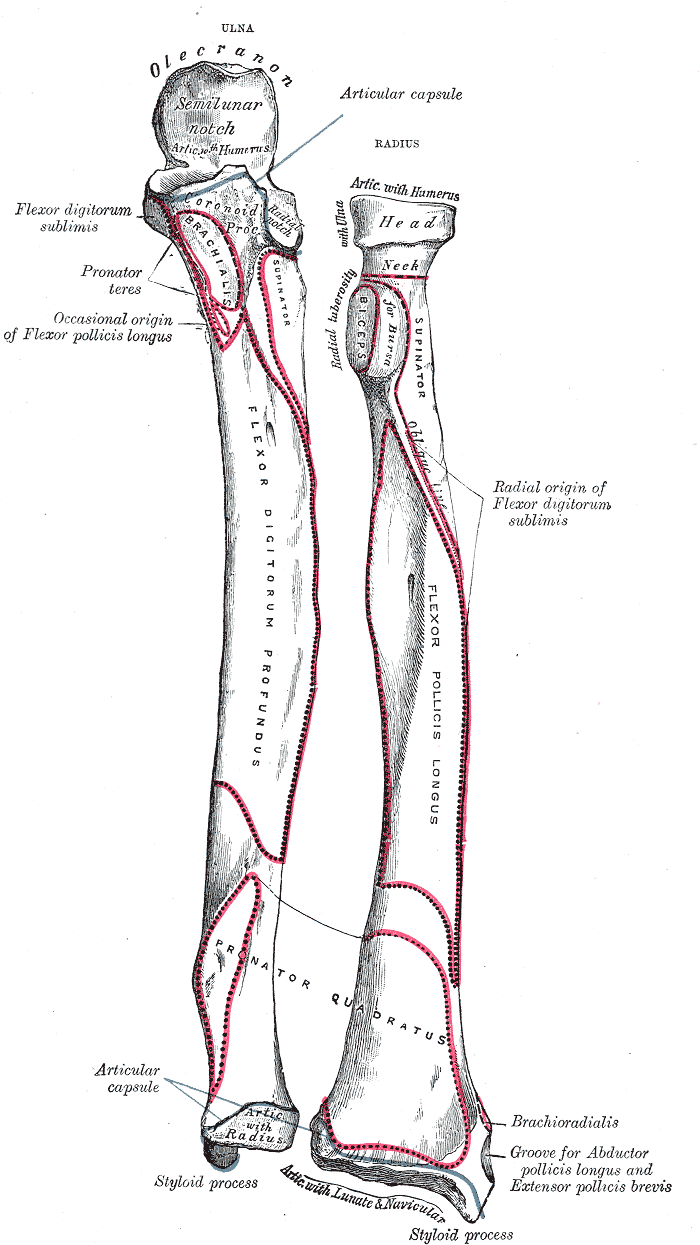
Regional anatomy: Beneath the skin, subcutaneous tissue and antebrachial fascia the needle passes between the tendons of palmaris longus and flexor carpi radialis into flexor digitorum superficialis, then flexor digitorum profundus and pronator quadratus; the median nerve lies directly beneath the point.
Distances are in cun, a proportional unit — how to measure.

3D view
The 3D view is not available on this device. The 2D maps above show the same point.
Drag, or focus the model and use the arrow keys, to rotate; + and − to zoom; 0 to reset; Esc to close.
Needle diagram for the marked point — a schematic section through the skin, not the model.
3D anatomy: BodyParts3D, © The Database Center for Life Science licensed under CC Attribution 4.0 International (licence). Subset, simplified and recoloured by Verscienta — changes and licence details.
Approximate placement, carried over from our 2D body map onto a single adult male model (BodyParts3D) and checked against the point's location text. Shown on one side of the body. Locate the point on your patient by the location text and palpation, not by this model.
- Cun on this part of the body
- From the cubital crease to the wrist crease: 12 B-cun (WHO 2008, General Guidelines, Proportional Bone (Skeletal) Measurements, p. 12). On the model, the cubital crease = line between the humeral epicondyles. On the model, the wrist crease = line between the radial and ulnar styloid tips.
- Needle angle and depth
-
- Perpendicular (90° to the skin), 0.5–1 cun. Deadman P, Al-Khafaji M, Baker K, p. 376
- Through needling, to waiguan te5 — not drawn: no cited depth in cun.
- Oblique (45° to the skin), 1–1.5 cun, proximal, for diseases of the chest. Deadman P, Al-Khafaji M, Baker K, p. 376
- Oblique (45° to the skin), 1–1.5 cun, distal, for numbness of the fingers. Deadman P, Al-Khafaji M, Baker K, p. 376
3D anatomy: BodyParts3D, © The Database Center for Life Science licensed under CC Attribution 4.0 International (licence). Subset, simplified and recoloured by Verscienta — changes and licence details.
Needling
Cited needling
Techniques — the source gives these as alternatives:
-
Perpendicular insertionDepth 0.5–1 cunskindeeper
-
Through-needling — to Waiguan TE5
-
Oblique insertion — proximal, for diseases of the chestDepth 1–1.5 cunskindeeper
-
Oblique insertion — distal, for numbness of the fingersDepth 1–1.5 cunskindeeper
Depths describe average adult habitus in the cited population, never a single safe number for the patient in front of you. Palpate and adjust.
Sources (1)
- Deadman P, Al-Khafaji M, Baker K. A Manual of Acupuncture. Hove: Journal of Chinese Medicine Publications; 1998 — p. 376 Supports: techniques (names this point)
Site notes · not cited
Functions
- Regulates the Heart and unbinds the chest
- Harmonises the Stomach and stops nausea and vomiting
- Calms the spirit and relieves anxiety
- Opens and regulates the Yin Wei Mai
- Regulates qi and relieves pain
Indications
Balance Method partners
Under Dr. Tan's six systems, PC6 at the forearm balances these channels at the regions its segment images.
-
1. Same Chinese nameLiver channelLower leg, Calf · Mirror (arm ↔ leg)Thigh · Reversed mirrorChest, Upper back · Image, head at the hand/footUpper abdomen, Lower back · Image, head toward the elbow/kneeSolve for the Liver channel →
-
2. Branching (Bie Jing / Zang Fu Bie Tong)Stomach channelLower leg, Calf · Mirror (arm ↔ leg)Thigh · Reversed mirrorChest, Upper back · Image, head at the hand/footUpper abdomen, Lower back · Image, head toward the elbow/kneeSolve for the Stomach channel →
-
3. Interior–exterior pairTriple Energiser channelForearm · Same segment, opposite sideChest, Upper back · Image, head at the hand/footUpper abdomen, Lower back · Image, head toward the elbow/kneeSolve for the Triple Energiser channel →
-
4. Chinese clock oppositeStomach channelLower leg, Calf · Mirror (arm ↔ leg)Thigh · Reversed mirrorChest, Upper back · Image, head at the hand/footUpper abdomen, Lower back · Image, head toward the elbow/kneeSolve for the Stomach channel →
-
5. Chinese clock neighbourKidney channelLower leg, Calf · Mirror (arm ↔ leg)Thigh · Reversed mirrorChest, Upper back · Image, head at the hand/footUpper abdomen, Lower back · Image, head toward the elbow/kneeSolve for the Kidney channel →
-
6. Same channelPericardium channelForearm · Same segment, opposite sideChest, Upper back · Image, head at the hand/footUpper abdomen, Lower back · Image, head toward the elbow/kneeSolve for the Pericardium channel →
Clinical Notes
Combinations Using This Point
Chong Mai Pair — PC6 and SP4
The opening pair of the Penetrating Vessel and Yin Wei — the standard combination for the epigastrium, the heart and the chest.
Neiguan and Ximen
PC6 and PC4, the Luo and Xi-Cleft points of the Pericardium — for cardiac pain, palpitations, insomnia, stomach pain, vomiting and hiccup.
Neiguan, Shenmen and Daling
PC6, HT7 and PC7 at the inner wrist — for cardiac pain, palpitations, insomnia, irritability and low mood.
Neiguan and Tanzhong
PC6 and CV17, the Luo and Front-Mu points of the Pericardium — for palpitations, chest pain and oppression, restlessness, insomnia and hiccup.
Calming the Spirit — HT7, PC6, Yintang and GV20
The four points most reached for in anxiety and insomnia — two distal, two on the midline of the head.
Zhongwan, Neiguan and Zusanli
CV12, PC6 and ST36 — the Stomach's Mu point with forearm and leg distal points — for vomiting, abdominal pain and distension, and bowel disorders.
Similar Points
Ranked by shared patterns and conditions
Sources
- World Health Organization. WHO Standard Acupuncture Point Locations in the Western Pacific Region. Manila: WHO Regional Office for the Western Pacific, 2008. (Location.)
- Focks C, ed. Atlas of Acupuncture. Edinburgh: Churchill Livingstone Elsevier, 2008. (Locating method and actions.)
📝 Notes
Public notes from the community and your own private notes on PC6 Neiguan.
No notes yet.