
膻中 (Dànzhōng) — Chest Centre
Ren (Conception) channel · point 17
Traditionally used for
- Nose & throat
- Cough & breathing
- Digestion
- Menstrual & women's health
- Mood & calm
- Heart & circulation
Location
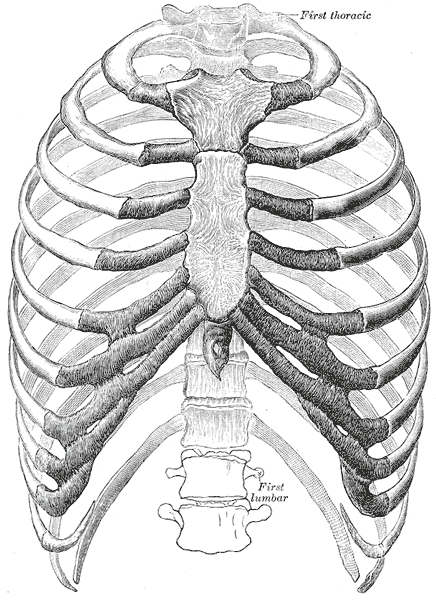
On the chest, on the anterior midline, level with the fourth intercostal space; in men this usually falls midway between the nipples.
How to locate: Find the sternal angle, the horizontal ridge where the manubrium meets the body of the sternum beside the second rib, and count down from the second intercostal space to the fourth; the point is on the midline at that level. In men it usually lies between the nipples; in women rely on the intercostal count.
Regional anatomy: Skin and a thin subcutaneous layer directly over the periosteum of the body of the sternum; a congenital sternal foramen is occasionally present here, so perpendicular needling is avoided in favour of transverse insertion.
Distances are in cun, a proportional unit — how to measure.

Needling
Cited needling
Techniques — the source gives these as alternatives:
-
Transverse insertion — directed superiorly or inferiorly along the channelDepth 0.5–1 cunskindeeper
-
Transverse insertion — directed laterally towards the breasts, for breast disordersDepth 1–1.5 cunskindeeper
Depths describe average adult habitus in the cited population, never a single safe number for the patient in front of you. Palpate and adjust.
Sources (1)
- Deadman P, Al-Khafaji M, Baker K. A Manual of Acupuncture. Hove: Journal of Chinese Medicine Publications; 1998 — p. 518 Supports: techniques (names this point)
Site notes · not cited
Functions
- Regulates qi and unbinds the chest
- Descends rebellious Lung and Stomach qi
- Benefits the breast and promotes lactation
- Calms the spirit
Indications
Clinical Notes
Combinations Using This Point
Tanzhong and Qimen
CV17 with LV14 — a chest-and-flank pairing that frees Liver qi and brings rebellious qi down in hypochondriac pain, belching and hiccup.
Neiguan and Tanzhong
PC6 and CV17, the Luo and Front-Mu points of the Pericardium — for palpitations, chest pain and oppression, restlessness, insomnia and hiccup.
Zhongwan, Qihai and Tanzhong
CV12, CV6 and CV17 on the Ren Mai — a three-level set that opens the chest and sends rebellious Lung and Stomach qi back down.
Sources
- World Health Organization. WHO Standard Acupuncture Point Locations in the Western Pacific Region. Manila: WHO Regional Office for the Western Pacific, 2008. (Location.)
- Focks C, ed. Atlas of Acupuncture. Edinburgh: Churchill Livingstone Elsevier, 2008. (Locating method and actions.)
📝 Notes
Public notes from the community and your own private notes on CV17 Tanzhong.
No notes yet.