
陽谿 (Yángxī) — Yang Ravine
Large Intestine channel · point 5
Traditionally used for
- Headaches
- Eye health
- Ears & hearing
- Nose & throat
- Teeth & mouth
- Mood & calm
Cautions & contraindications
- Avoid blood vessels
Location
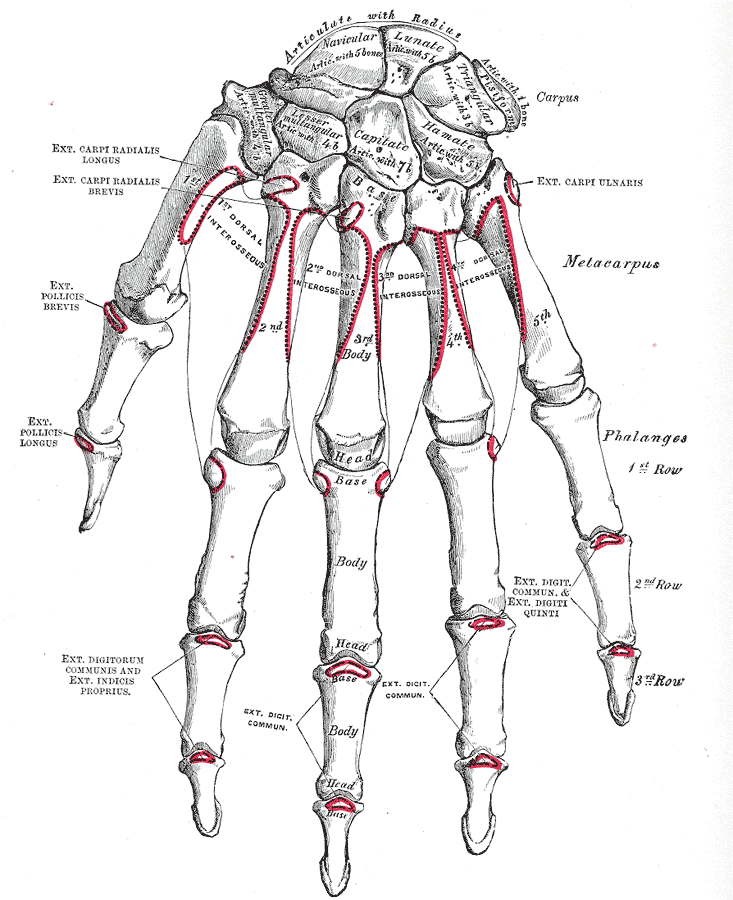
On the posterolateral aspect of the wrist, at the radial end of the dorsal wrist crease, distal to the radial styloid process, in the depression of the anatomical snuffbox between the tendons of extensor pollicis longus and brevis.
How to locate: Extend and abduct the thumb fully; the hollow between the two prominent tendons at its base is the anatomical snuffbox. The point is in it at the level of the wrist joint, which you can feel by gently moving the wrist.
Regional anatomy: The needle passes through the extensor retinaculum between the tendons of extensor pollicis longus and brevis, reaching the tendon of extensor carpi radialis longus; the radial artery runs through the floor of the snuffbox.
Distances are in cun, a proportional unit — how to measure.
Needling
Cited needling
-
Perpendicular insertionDepth 0.5–1 cunskindeeper
Second source — Beijing College of Traditional Chinese Medicine, et al 1980, p. 117:
-
Perpendicular insertionDepth 0.3–0.5 in (≈8–13 mm)skindeeper
Depths describe average adult habitus in the cited population, never a single safe number for the patient in front of you. Palpate and adjust.
Sources (2)
- Deadman P, Al-Khafaji M, Baker K. A Manual of Acupuncture. Hove: Journal of Chinese Medicine Publications; 1998 — p. 106 Supports: techniques (names this point)
- Beijing College of Traditional Chinese Medicine, et al. Essentials of Chinese Acupuncture. Beijing: Foreign Languages Press; 1980 — p. 117 Supports: techniques (names this point)
Site notes · not cited
- Avoid blood vessels
Functions
- Clears heat and fire from the Yangming and expels wind
- Calms the spirit
- Benefits the wrist
Indications
Balance Method partners
Under Dr. Tan's six systems, LI5 at the wrist balances these channels at the regions its segment images.
-
1. Same Chinese nameStomach channelAnkle, Heel · Mirror (arm ↔ leg)Hip & groin, Buttock · Reversed mirrorFront of neck, Nape of neck · Image, head at the hand/footLower abdomen, Sacrum · Image, head toward the elbow/kneeSolve for the Stomach channel →
-
2. Branching (Bie Jing / Zang Fu Bie Tong)Liver channelAnkle, Heel · Mirror (arm ↔ leg)Hip & groin, Buttock · Reversed mirrorFront of neck, Nape of neck · Image, head at the hand/footLower abdomen, Sacrum · Image, head toward the elbow/kneeSolve for the Liver channel →
-
3. Interior–exterior pairLung channelWrist · Same segment, opposite sideFront of neck, Nape of neck · Image, head at the hand/footLower abdomen, Sacrum · Image, head toward the elbow/kneeSolve for the Lung channel →
-
4. Chinese clock oppositeKidney channelAnkle, Heel · Mirror (arm ↔ leg)Hip & groin, Buttock · Reversed mirrorFront of neck, Nape of neck · Image, head at the hand/footLower abdomen, Sacrum · Image, head toward the elbow/kneeSolve for the Kidney channel →
-
5. Chinese clock neighbourStomach channelAnkle, Heel · Mirror (arm ↔ leg)Hip & groin, Buttock · Reversed mirrorFront of neck, Nape of neck · Image, head at the hand/footLower abdomen, Sacrum · Image, head toward the elbow/kneeSolve for the Stomach channel →
-
6. Same channelLarge Intestine channelWrist · Same segment, opposite sideFront of neck, Nape of neck · Image, head at the hand/footLower abdomen, Sacrum · Image, head toward the elbow/kneeSolve for the Large Intestine channel →
Classical calendar method · 子午流注
When the tables open LI5
The hours Zi Wu Liu Zhu names this point at, by method. Times are the double-hour's start in America/New_York.
-
庚辰 07:00–09:00 Na Jia Fa, 甲-day sequence · Jing-River (經)
「庚辰經注陽谿穴」
Next: Mon 7 Dec, 07:00
A classical reference, not a recommendation: the tables say when the method opens this point, not that it is the point to needle. Open points by the hour →
Combinations Using This Point
Yangxi, Yangchi and Yanggu
LI5, TE4 and SI5 across the back of the wrist — for wrist pain, febrile disease and red, swollen, painful eyes.
Balance Method for Ankle and Wrist Sprain
An ankle sprain treated at the opposite wrist, and a wrist sprain at the opposite ankle, on the corresponding channel.
Bi syndrome — wrist
TE4, LI5, SI5 and TE5 on the back of the wrist, for bi pain of the wrist.
Sources
- World Health Organization. WHO Standard Acupuncture Point Locations in the Western Pacific Region. Manila: WHO Regional Office for the Western Pacific, 2008. (Location.)
- Focks C, ed. Atlas of Acupuncture. Edinburgh: Churchill Livingstone Elsevier, 2008. (Locating method, actions and needling cautions.)
Professional contributions
Clinical notes and case studies from verified practitioners, reviewed by our team before they appear. Each entry is one practitioner's report — not editorial content, and not a dosing reference.
No professional contributions yet.
Verified professionals with a live directory listing can share clinical notes and case studies here.
📝 Notes
Public notes from the community and your own private notes on LI5 Yangxi.
No notes yet.