
Traditionally used for
- Menstrual & women's health
- Fertility & vitality
Cautions & contraindications
- Pregnancy
Location
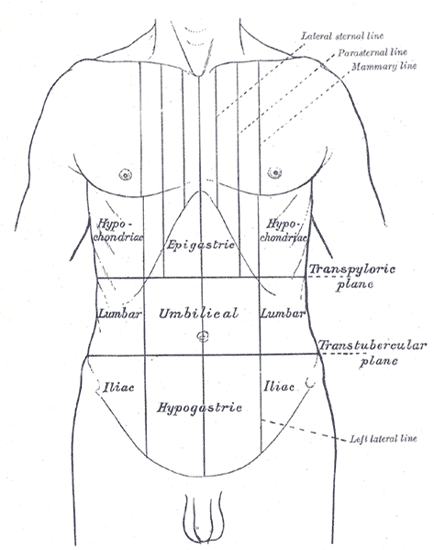
On the lower abdomen, 4 cun below the umbilicus, 2 cun lateral to the anterior midline.
How to locate: With the patient supine and the bladder emptied, find CV3 on the midline 4 cun below the umbilicus (1 cun above the upper border of the pubic symphysis); the point is 2 cun lateral to it.
Regional anatomy: Beneath the skin and subcutaneous tissue the needle passes through the anterior rectus sheath, rectus abdominis and the posterior layer of the sheath toward the peritoneum; a full bladder may lie beneath.
Distances are in cun, a proportional unit — how to measure.
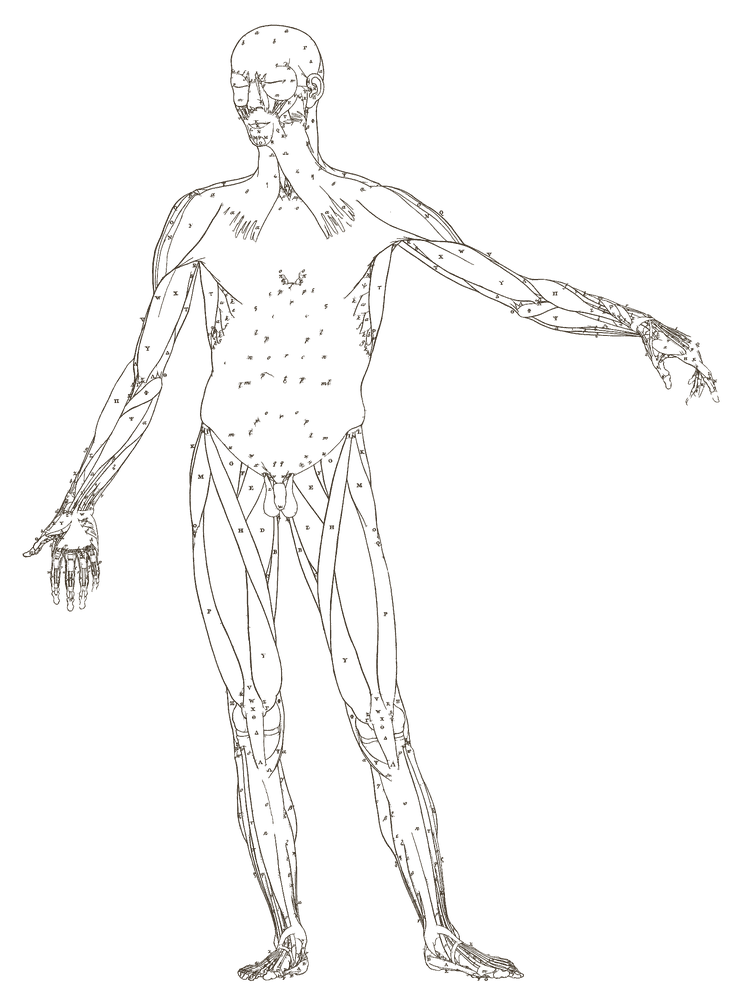
3D view
The 3D view is not available on this device. The 2D maps above show the same point.
Drag, or focus the model and use the arrow keys, to rotate; + and − to zoom; 0 to reset; Esc to close.
Needle diagram for the marked point — a schematic section through the skin, not the model.
3D anatomy: BodyParts3D, © The Database Center for Life Science licensed under CC Attribution 4.0 International (licence). Subset, simplified and recoloured by Verscienta — changes and licence details.
Approximate placement, carried over from our 2D body map onto a single adult male model (BodyParts3D) and checked against the point's location text. Shown on one side of the body. Locate the point on your patient by the location text and palpation, not by this model.
- Cun on this part of the body
- From the centre of the umbilicus to the superior border of the pubic symphysis: 5 B-cun (WHO 2008, General Guidelines, Proportional Bone (Skeletal) Measurements, p. 12).
- Needle angle and depth
-
- Perpendicular (90° to the skin), 1–1.5 cun. Deadman P, Al-Khafaji M, Baker K, p. 151
3D anatomy: BodyParts3D, © The Database Center for Life Science licensed under CC Attribution 4.0 International (licence). Subset, simplified and recoloured by Verscienta — changes and licence details.
Needling
Cited needling
-
Perpendicular insertionDepth 1–1.5 cunskindeeper
Second source — Beijing College of Traditional Chinese Medicine, et al 1980, p. 135:
-
Perpendicular insertionDepth 0.7–1.2 in (≈18–30 mm)skindeeper
Depths describe average adult habitus in the cited population, never a single safe number for the patient in front of you. Palpate and adjust.
Sources (2)
- Deadman P, Al-Khafaji M, Baker K. A Manual of Acupuncture. Hove: Journal of Chinese Medicine Publications; 1998 — p. 151 Supports: techniques (names this point)
- Beijing College of Traditional Chinese Medicine, et al. Essentials of Chinese Acupuncture. Beijing: Foreign Languages Press; 1980 — p. 135 Supports: techniques (names this point)
Site notes · not cited
- Pregnancy
Functions
- Warms and regulates the lower burner
- Regulates menstruation and stops discharge
- Raises and returns prolapse
Indications
Clinical Notes
Combinations Using This Point
Abdominal pain — lower abdomen
SP6 with ST29 and CV4 for pain in the lower abdomen, where the three foot yin channels run.
Guanyuan, Zhongji and Guilai
CV4, CV3 and ST29 on the lower abdomen — clears damp-heat, supports the Kidney and regulates menstruation in urogenital and pelvic disorders.
Amenorrhoea — blood stasis
CV3, SP10, SP6, LV2, ST29, BL32 and LI4, reduced, to break up blood stasis when menstruation has stopped.
Sources
- World Health Organization. WHO Standard Acupuncture Point Locations in the Western Pacific Region. Manila: WHO Regional Office for the Western Pacific, 2008. (Location.)
Professional contributions
Clinical notes and case studies from verified practitioners, reviewed by our team before they appear. Each entry is one practitioner's report — not editorial content, and not a dosing reference.
No professional contributions yet.
Verified professionals with a live directory listing can share clinical notes and case studies here.
📝 Notes
Public notes from the community and your own private notes on ST29 Guilai.
No notes yet.