
天池 (Tiānchí) — Celestial Pool
Pericardium channel · point 1
Traditionally used for
- Cough & breathing
- Menstrual & women's health
Cautions & contraindications
- No deep needling
Location
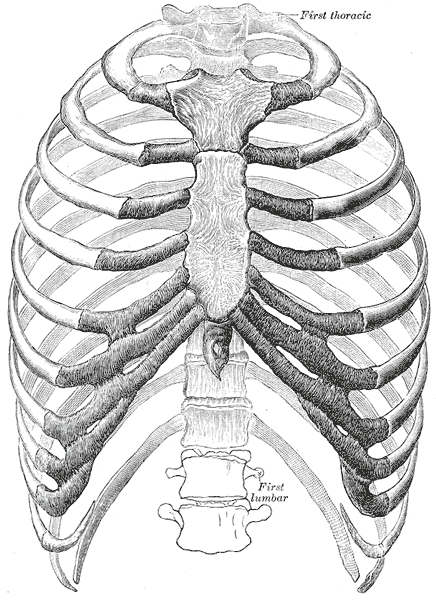
On the chest, in the fourth intercostal space, 5 cun lateral to the anterior midline (in men, about 1 cun lateral to the nipple).
How to locate: Count down from the sternal angle (level with the second rib) to the fourth intercostal space; in men the nipple usually lies in this space. The point is in the fourth space 5 cun from the midline, about 1 cun lateral to the nipple, remembering that the space rises slightly as it runs laterally.
Distances are in cun, a proportional unit — how to measure.

 Needling hazard — see Needling safety
3D view
3D view not available for this point: its position on the 3D model couldn't be checked against its location text, so it is not shown. The 2D maps above show it.
- The lung is not drawn: the anatomical model used here does not include it as a surface. This is a limit of the model, not of the anatomy. The pneumothorax risk above still applies.
Needling
Cited needling
- ⚠ Pneumothorax
-
Transverse-oblique insertion — posteriorly along the intercostal spaceDepth 0.5–1 cunskindeeper
| Underweight | Normal | Overweight | |
|---|---|---|---|
| Men | 11.8 | 22.5 | 26.4 |
| Women | 18.9 | 28.6 | 33.4 |
CT-measured mean safe needling depths from Taiwanese adults, by sex and body size (Lin et al. 2013); population-specific and a guide only — adjust to the patient in front of you.
Depths describe average adult habitus in the cited population, never a single safe number for the patient in front of you. Palpate and adjust.
Sources (3)
- Lin JG, Chou PC, Chu HY. An exploration of the needling depth in acupuncture: the safe needling depth and the needling depth of clinical efficacy. Evid Based Complement Alternat Med. 2013;2013:740508 — Tables 7 (male) and 8 (female), chest acupoints Supports: safe depth (measured)
- World Health Organization. Guidelines on basic training and safety in acupuncture. Geneva: WHO; 1999. WHO/EDM/TRM/99.1 — Section II §5.2 (Lung and pleura), p. 25 Supports: pneumothorax (names this region)
- Deadman P, Al-Khafaji M, Baker K. A Manual of Acupuncture. Hove: Journal of Chinese Medicine Publications; 1998 — p. 370 Supports: techniques (names this point)
Site notes · not cited
- No deep needling
Functions
- Unbinds the chest and regulates qi
- Descends rebellious qi
- Clears heat and transforms phlegm in the chest
- Benefits the breast, promotes lactation and dissipates nodules
Indications
Similar Points
Sources
- World Health Organization. WHO Standard Acupuncture Point Locations in the Western Pacific Region. Manila: WHO Regional Office for the Western Pacific, 2008. (Location.)
- Focks C, ed. Atlas of Acupuncture. Edinburgh: Churchill Livingstone Elsevier, 2008. (Locating method and actions.)
📝 Notes
Public notes from the community and your own private notes on PC1 Tianchi.
No notes yet.