
陽交 (Yángjiāo) — Yang Intersection
Gallbladder channel · point 35
Traditionally used for
- Urinary & fluids
- Mood & calm
- Pain & joints
Location
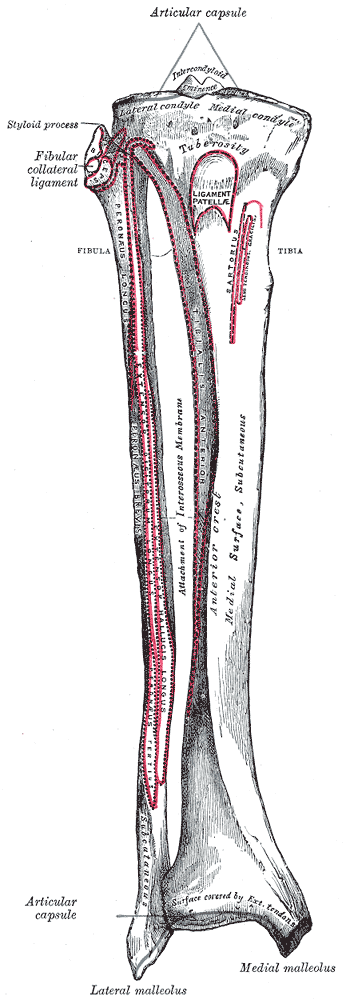
On the fibular (lateral) aspect of the lower leg, 7 cun above the prominence of the lateral malleolus, just posterior to the fibula (behind GB36).
How to locate: Measure 7 cun above the prominence of the lateral malleolus, the midpoint of the line from GB34 to the malleolus (or 1 cun below the midpoint between the malleolus and the popliteal crease); the point is just behind the fibula, beside GB36. The fibula is deep here, so trace its posterior border up from just above the ankle.
Regional anatomy: Vessels: the branches of the peroneal artery and vein. Nerves: the lateral sural cutaneous nerve.
Distances are in cun, a proportional unit — how to measure.
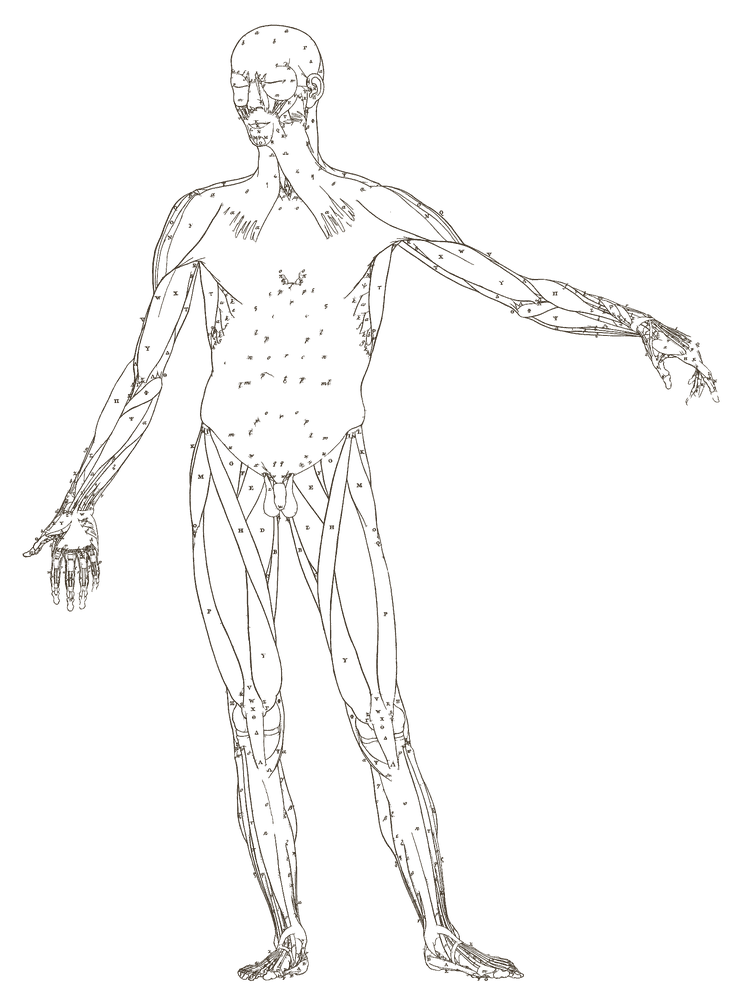
3D view
The 3D view is not available on this device. The 2D maps above show the same point.
Drag, or focus the model and use the arrow keys, to rotate; + and − to zoom; 0 to reset; Esc to close.
Needle diagram for the marked point — a schematic section through the skin, not the model.
3D anatomy: BodyParts3D, © The Database Center for Life Science licensed under CC Attribution 4.0 International (licence). Subset, simplified and recoloured by Verscienta — changes and licence details.
Approximate placement, set from the point's location text against bone landmarks on a single adult male model (BodyParts3D), where our 2D body map disagreed with that text. Shown on one side of the body. Locate the point on your patient by the location text and palpation, not by this model.
- Cun on this part of the body
- From the popliteal crease to the prominence of the lateral malleolus: 16 B-cun (WHO 2008, General Guidelines, Proportional Bone (Skeletal) Measurements, p. 13). On the model, the popliteal crease = knee joint line (femoral condyles / tibial plateau).
- Needle angle and depth
-
- Perpendicular (90° to the skin), 1–1.5 cun. Deadman P, Al-Khafaji M, Baker K, p. 453
3D anatomy: BodyParts3D, © The Database Center for Life Science licensed under CC Attribution 4.0 International (licence). Subset, simplified and recoloured by Verscienta — changes and licence details.
Needling
Cited needling
-
Perpendicular insertionDepth 1–1.5 cunskindeeper
Second source — Beijing College of Traditional Chinese Medicine, et al 1980, p. 244:
-
Perpendicular insertionDepth 0.5–0.8 in (≈13–20 mm)skindeeper
Depths describe average adult habitus in the cited population, never a single safe number for the patient in front of you. Palpate and adjust.
Sources (2)
- Deadman P, Al-Khafaji M, Baker K. A Manual of Acupuncture. Hove: Journal of Chinese Medicine Publications; 1998 — p. 453 Supports: techniques (names this point)
- Beijing College of Traditional Chinese Medicine, et al. Essentials of Chinese Acupuncture. Beijing: Foreign Languages Press; 1980 — p. 244 Supports: techniques (names this point)
Site notes · not cited
Functions
- Calms the spirit and settles agitation
- Regulates Gallbladder qi
- Clears heat
- Relaxes the sinews, activates the channel and relieves pain
Indications
Balance Method partners
Under Dr. Tan's six systems, GB35 at the lower leg balances these channels at the regions its segment images.
-
1. Same Chinese nameTriple Energiser channelForearm · Mirror (arm ↔ leg)Upper arm · Reversed mirrorChest, Upper back · Image, head at the hand/footUpper abdomen, Lower back · Image, head toward the elbow/kneeSolve for the Triple Energiser channel →
-
2. Branching (Bie Jing / Zang Fu Bie Tong)Heart channelForearm · Mirror (arm ↔ leg)Upper arm · Reversed mirrorChest, Upper back · Image, head at the hand/footUpper abdomen, Lower back · Image, head toward the elbow/kneeSolve for the Heart channel →
-
3. Interior–exterior pairLiver channelLower leg, Calf · Same segment, opposite sideChest, Upper back · Image, head at the hand/footUpper abdomen, Lower back · Image, head toward the elbow/kneeSolve for the Liver channel →
-
4. Chinese clock oppositeHeart channelForearm · Mirror (arm ↔ leg)Upper arm · Reversed mirrorChest, Upper back · Image, head at the hand/footUpper abdomen, Lower back · Image, head toward the elbow/kneeSolve for the Heart channel →
-
5. Chinese clock neighbourTriple Energiser channelForearm · Mirror (arm ↔ leg)Upper arm · Reversed mirrorChest, Upper back · Image, head at the hand/footUpper abdomen, Lower back · Image, head toward the elbow/kneeSolve for the Triple Energiser channel →
-
6. Same channelGallbladder channelLower leg, Calf · Same segment, opposite sideChest, Upper back · Image, head at the hand/footUpper abdomen, Lower back · Image, head toward the elbow/kneeSolve for the Gallbladder channel →
Sources
- World Health Organization. WHO Standard Acupuncture Point Locations in the Western Pacific Region. Manila: WHO Regional Office for the Western Pacific, 2008. (Location.)
- Focks C, ed. Atlas of Acupuncture. Edinburgh: Churchill Livingstone Elsevier, 2008. (Locating method and actions.)
- Beijing College of Traditional Chinese Medicine, Shanghai College of Traditional Chinese Medicine, Nanjing College of Traditional Chinese Medicine, Acupuncture Institute of the Academy of Traditional Chinese Medicine. Essentials of Chinese Acupuncture. Beijing: Foreign Languages Press, 1980. (Regional anatomy.)
Professional contributions
Clinical notes and case studies from verified practitioners, reviewed by our team before they appear. Each entry is one practitioner's report — not editorial content, and not a dosing reference.
No professional contributions yet.
Verified professionals with a live directory listing can share clinical notes and case studies here.
📝 Notes
Public notes from the community and your own private notes on GB35 Yangjiao.
No notes yet.