
合陽 (Héyáng) — Confluence of Yang
Bladder channel · point 55
Traditionally used for
- Menstrual & women's health
- Pain & joints
Location
On the back of the lower leg, 2 cun below BL40, between the two heads of gastrocnemius.
How to locate: With the patient prone and the knee slightly flexed, find BL40 at the midpoint of the popliteal crease. The point is 2 cun directly below it, in the depression between the two heads of gastrocnemius, on the line towards BL57.
Distances are in cun, a proportional unit — how to measure.
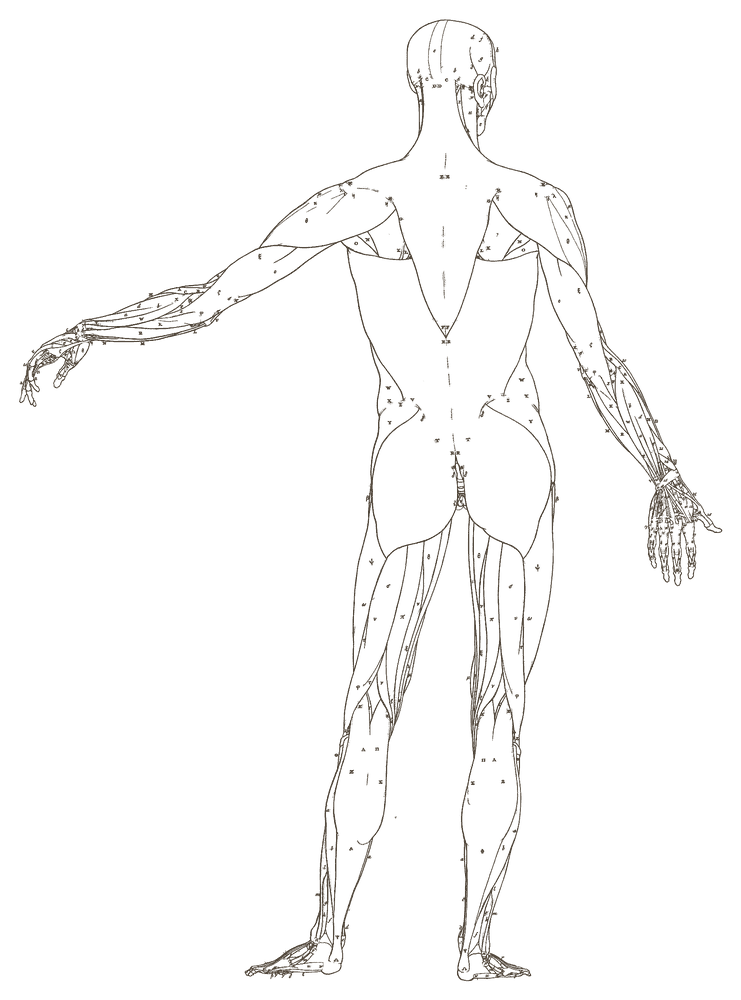
3D view
The 3D view is not available on this device. The 2D maps above show the same point.
Drag, or focus the model and use the arrow keys, to rotate; + and − to zoom; 0 to reset; Esc to close.
Needle diagram for the marked point — a schematic section through the skin, not the model.
3D anatomy: BodyParts3D, © The Database Center for Life Science licensed under CC Attribution 4.0 International (licence). Subset, simplified and recoloured by Verscienta — changes and licence details.
Approximate placement, carried over from our 2D body map onto a single adult male model (BodyParts3D) and checked against the point's location text. Shown on one side of the body. Locate the point on your patient by the location text and palpation, not by this model.
- Cun on this part of the body
- From the popliteal crease to the prominence of the lateral malleolus: 16 B-cun (WHO 2008, General Guidelines, Proportional Bone (Skeletal) Measurements, p. 13). On the model, the popliteal crease = knee joint line (femoral condyles / tibial plateau).
- Needle angle and depth
-
- Perpendicular (90° to the skin), 1–1.5 cun. Deadman P, Al-Khafaji M, Baker K, p. 313
3D anatomy: BodyParts3D, © The Database Center for Life Science licensed under CC Attribution 4.0 International (licence). Subset, simplified and recoloured by Verscienta — changes and licence details.
Needling
Cited needling
-
Perpendicular insertionDepth 1–1.5 cunskindeeper
Depths describe average adult habitus in the cited population, never a single safe number for the patient in front of you. Palpate and adjust.
Sources (1)
- Deadman P, Al-Khafaji M, Baker K. A Manual of Acupuncture. Hove: Journal of Chinese Medicine Publications; 1998 — p. 313 Supports: techniques (names this point)
Site notes · not cited
Functions
- Activates the channel and relieves pain
- Regulates the lower burner and stops uterine bleeding
Indications
Balance Method partners
Under Dr. Tan's six systems, BL55 at the calf balances these channels at the regions its segment images.
-
1. Same Chinese nameSmall Intestine channelForearm · Mirror (arm ↔ leg)Upper arm · Reversed mirrorChest, Upper back · Image, head at the hand/footUpper abdomen, Lower back · Image, head toward the elbow/kneeSolve for the Small Intestine channel →
-
2. Branching (Bie Jing / Zang Fu Bie Tong)Lung channelForearm · Mirror (arm ↔ leg)Upper arm · Reversed mirrorChest, Upper back · Image, head at the hand/footUpper abdomen, Lower back · Image, head toward the elbow/kneeSolve for the Lung channel →
-
3. Interior–exterior pairKidney channelLower leg, Calf · Same segment, opposite sideChest, Upper back · Image, head at the hand/footUpper abdomen, Lower back · Image, head toward the elbow/kneeSolve for the Kidney channel →
-
4. Chinese clock oppositeLung channelForearm · Mirror (arm ↔ leg)Upper arm · Reversed mirrorChest, Upper back · Image, head at the hand/footUpper abdomen, Lower back · Image, head toward the elbow/kneeSolve for the Lung channel →
-
5. Chinese clock neighbourSmall Intestine channelForearm · Mirror (arm ↔ leg)Upper arm · Reversed mirrorChest, Upper back · Image, head at the hand/footUpper abdomen, Lower back · Image, head toward the elbow/kneeSolve for the Small Intestine channel →
-
6. Same channelBladder channelLower leg, Calf · Same segment, opposite sideChest, Upper back · Image, head at the hand/footUpper abdomen, Lower back · Image, head toward the elbow/kneeSolve for the Bladder channel →
Sources
- World Health Organization. WHO Standard Acupuncture Point Locations in the Western Pacific Region. Manila: WHO Regional Office for the Western Pacific, 2008. (Location.)
- Focks C, ed. Atlas of Acupuncture. Edinburgh: Churchill Livingstone Elsevier, 2008. (Locating method and actions.)
📝 Notes
Public notes from the community and your own private notes on BL55 Heyang.
No notes yet.