
譩譆 (Yìxǐ) — Yi Xi
Bladder channel · point 45
Traditionally used for
- Dizziness
- Nose & throat
- Cough & breathing
- Colds & fever
- Pain & joints
Cautions & contraindications
- No deep needling
Location
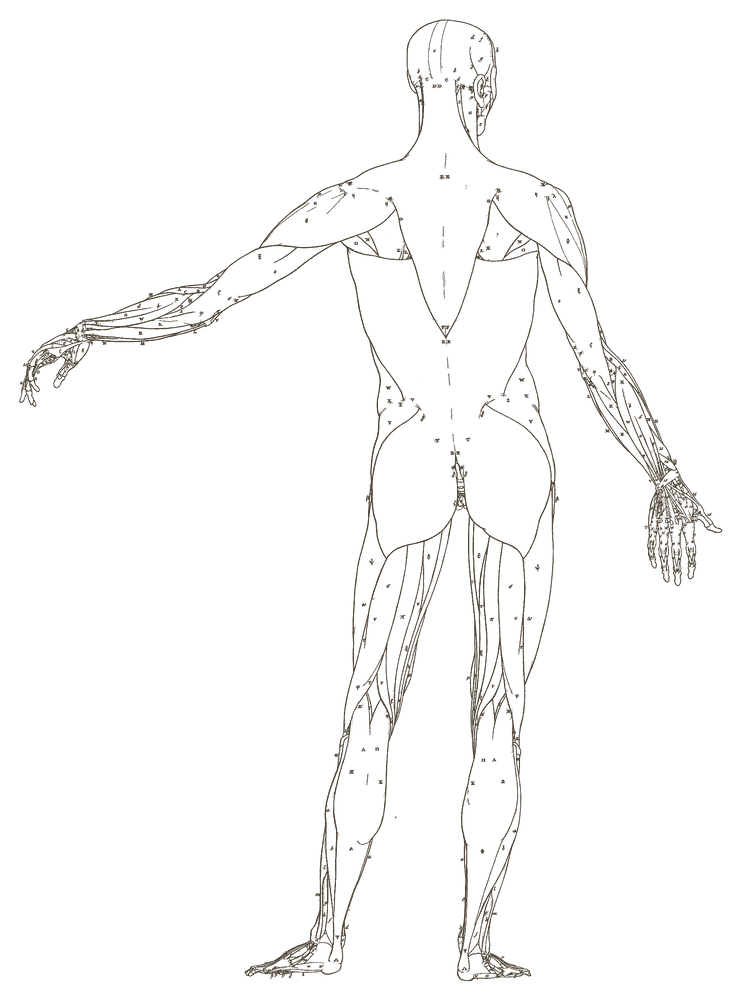
On the back, 3 cun lateral to the lower border of the spinous process of T6.
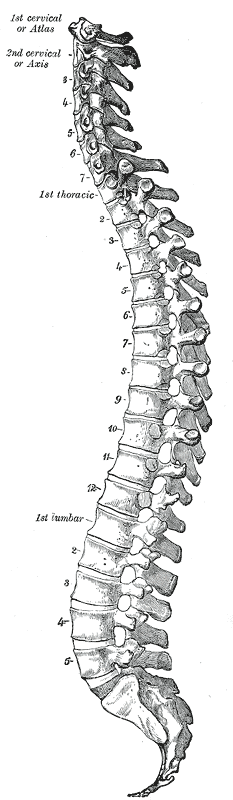
How to locate: With the patient seated and the arms hanging relaxed, the inferior angle of the scapula is level with the T7 spinous process; move up one to T6 (or count down six from C7). The point is 3 cun lateral to the lower border of the T6 spinous process, level with BL16 and GV10.
Regional anatomy: Vessels: the posterior branches of the intercostal artery and vein. Nerves: the medial cutaneous branches of the posterior rami of the 5th and 6th thoracic nerves; deeper, their lateral branches.
Distances are in cun, a proportional unit — how to measure.
 Needling hazard — see Needling safety
3D view
The 3D view is not available on this device. The 2D maps above show the same point.
Drag, or focus the model and use the arrow keys, to rotate; + and − to zoom; 0 to reset; Esc to close.
Needle diagram for the marked point — a schematic section through the skin, not the model.
3D anatomy: BodyParts3D, © The Database Center for Life Science licensed under CC Attribution 4.0 International (licence). Subset, simplified and recoloured by Verscienta — changes and licence details.
Approximate placement, carried over from our 2D body map onto a single adult male model (BodyParts3D) and checked against the point's location text. Shown on one side of the body. Locate the point on your patient by the location text and palpation, not by this model.
- Cun on this part of the body
- Between the bilateral medial borders of the scapula: 6 B-cun; this scale is half of the 6 B-cun between the two medial borders (posterior midline to one border), 3 B-cun (WHO 2008, General Guidelines, Proportional Bone (Skeletal) Measurements, p. 12).
- Needle angle and depth
-
- Oblique (45° to the skin), 0.3–0.5 cun. Deadman P, Al-Khafaji M, Baker K, p. 305
- The lung is not drawn: the anatomical model used here does not include it as a surface. This is a limit of the model, not of the anatomy. The pneumothorax risk above still applies.
3D anatomy: BodyParts3D, © The Database Center for Life Science licensed under CC Attribution 4.0 International (licence). Subset, simplified and recoloured by Verscienta — changes and licence details.
Needling
Cited needling
- ⚠ Pneumothorax
-
Oblique insertionDepth 0.3–0.5 cunskindeeper
Second source — Beijing College of Traditional Chinese Medicine, et al 1980, p. 189:
-
Oblique insertion — downwardDepth 0.5–0.5 in (≈13–13 mm)skindeeper
| Underweight | Normal | Overweight | |
|---|---|---|---|
| Men | 22.8 | 27.6 | 37.0 |
| Women | 18.8 | 25.6 | 35.9 |
CT-measured mean safe needling depths from Taiwanese adults, by sex and body size (Lin et al. 2013); population-specific and a guide only — adjust to the patient in front of you.
Depths describe average adult habitus in the cited population, never a single safe number for the patient in front of you. Palpate and adjust.
Sources (4)
- Lin JG, Chou PC, Chu HY. An exploration of the needling depth in acupuncture: the safe needling depth and the needling depth of clinical efficacy. Evid Based Complement Alternat Med. 2013;2013:740508 — Tables 9 (male) and 10 (female), back acupoints Supports: safe depth (measured)
- World Health Organization. Guidelines on basic training and safety in acupuncture. Geneva: WHO; 1999. WHO/EDM/TRM/99.1 — Section II §5.2 (Lung and pleura), p. 25 Supports: pneumothorax (names this region)
- Deadman P, Al-Khafaji M, Baker K. A Manual of Acupuncture. Hove: Journal of Chinese Medicine Publications; 1998 — p. 305 Supports: techniques (names this point)
- Beijing College of Traditional Chinese Medicine, et al. Essentials of Chinese Acupuncture. Beijing: Foreign Languages Press; 1980 — p. 189 Supports: techniques (names this point)
Site notes · not cited
- No deep needling
Functions
- Expels pathogenic factors, especially wind-heat
- Descends Lung qi and unbinds the chest
- Strengthens qi and blood and relieves pain of the back and shoulder
Indications
Sources
- World Health Organization. WHO Standard Acupuncture Point Locations in the Western Pacific Region. Manila: WHO Regional Office for the Western Pacific, 2008. (Location.)
- Focks C, ed. Atlas of Acupuncture. Edinburgh: Churchill Livingstone Elsevier, 2008. (Locating method and actions.)
- Beijing College of Traditional Chinese Medicine, Shanghai College of Traditional Chinese Medicine, Nanjing College of Traditional Chinese Medicine, Acupuncture Institute of the Academy of Traditional Chinese Medicine. Essentials of Chinese Acupuncture. Beijing: Foreign Languages Press, 1980. (Regional anatomy.)
Professional contributions
Clinical notes and case studies from verified practitioners, reviewed by our team before they appear. Each entry is one practitioner's report — not editorial content, and not a dosing reference.
No professional contributions yet.
Verified professionals with a live directory listing can share clinical notes and case studies here.
📝 Notes
Public notes from the community and your own private notes on BL45 Yixi.
No notes yet.