
承泣 (Chéngqì) — Container of Tears
Stomach channel · point 1
Traditionally used for
- Eye health
- Nerves & recovery
- Skin
Location
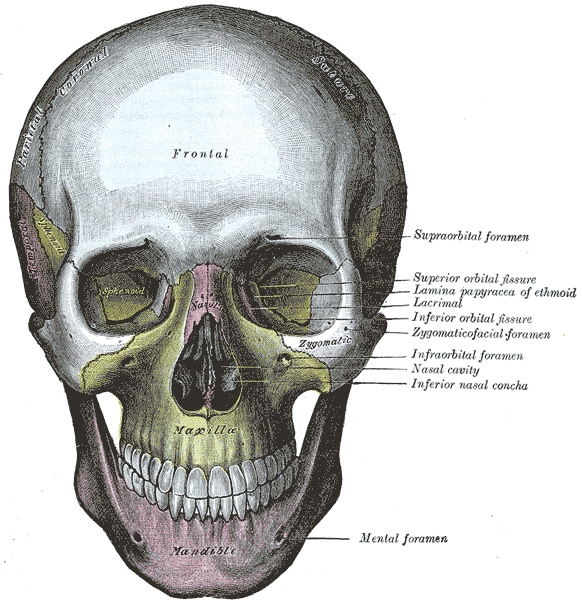
On the face, directly below the pupil, between the eyeball and the infraorbital ridge.
How to locate: With the patient seated or supine and looking straight ahead, place a finger directly below the pupil and feel for the bony infraorbital margin; the point is in the soft depression between that ridge and the eyeball.
Regional anatomy: The needle passes through the skin and orbicularis oculi of the lower lid into the orbit between the eyeball and the orbital floor, near inferior oblique and inferior rectus; the orbit is richly vascular and bruises easily.
Distances are in cun, a proportional unit — how to measure.

 Needling hazard — see Needling safety
3D view
3D view not available for this point: its position on the 3D model couldn't be checked against its location text, so it is not shown. The 2D maps above show it.
- The 3D view is not available for this point, so the eyeball is not drawn. The eye risk above still applies.
Needling
Cited needling
- ⚠ Eye
-
Perpendicular insertion — between the eyeball and the inferior wall of the orbitDepth 0.5–1 cunskindeeper
With the patient's eyes closed and looking upwards, push the eyeball up with a finger; insert first slightly inferiorly, then perpendicularly.
Depths describe average adult habitus in the cited population, never a single safe number for the patient in front of you. Palpate and adjust.
Sources (2)
- World Health Organization. Guidelines on basic training and safety in acupuncture. Geneva: WHO; 1999. WHO/EDM/TRM/99.1 — Section II §5.2 (Other points), p. 25 Supports: eye (names this point)
- Deadman P, Al-Khafaji M, Baker K. A Manual of Acupuncture. Hove: Journal of Chinese Medicine Publications; 1998 — p. 130 Supports: techniques (names this point)
Site notes · not cited
Functions
- Expels wind, clears heat and benefits the eyes
- Stops lacrimation
Indications
Combinations Using This Point
Similar Points
Sources
- World Health Organization. WHO Standard Acupuncture Point Locations in the Western Pacific Region. Manila: WHO Regional Office for the Western Pacific, 2008. (Location.)
- Focks C, ed. Atlas of Acupuncture. Edinburgh: Churchill Livingstone Elsevier, 2008. (Locating method and actions.)
📝 Notes
Public notes from the community and your own private notes on ST1 Chengqi.
No notes yet.