
下髎 (Xiàliáo) — Lower Bone-Hole
Bladder channel · point 34
Traditionally used for
- Digestion
- Bowel health
- Urinary & fluids
Cautions & contraindications
- Pregnancy
Location
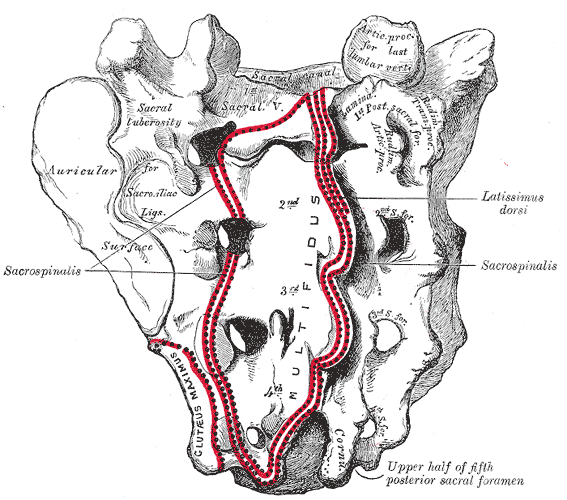
On the sacrum, in the fourth posterior sacral foramen, level with the sacral hiatus.
How to locate: With the patient prone, rest the little finger on the fourth posterior sacral foramen, usually level with the top of the gluteal cleft (and with the sacral hiatus), then lay the ring, middle and index fingers upwards in a slight V over the depressions of the other foramina; the point is under the little finger, in the fourth foramen, level with the sacral hiatus and the second depression below BL32.
Regional anatomy: Vessels: the branches of the inferior gluteal artery and vein. Nerves: on the course of the posterior ramus of the 4th sacral nerve.
Distances are in cun, a proportional unit — how to measure.
Needling
Cited needling
- Pregnancy: contraindicated
Techniques — the source gives these as alternatives:
-
Perpendicular insertionDepth 0.5–1 cunskindeeper
-
Perpendicular insertion — through the foramenDepth 1.5–2 cunskindeeper
Needling through the foramen is easier with a slightly oblique medial and inferior insertion.
Second source — Beijing College of Traditional Chinese Medicine, et al 1980, p. 185:
-
Perpendicular insertionDepth 0.5–1 in (≈13–25 mm)skindeeper
Traditionally forbidden in pregnancy (at least before 37 weeks). Carr (2015) reviewed the trials and found no objective evidence of harm from needling these points; the prohibition is traditional, not evidence-based.
Depths describe average adult habitus in the cited population, never a single safe number for the patient in front of you. Palpate and adjust.
Sources (4)
- Carr DJ. The safety of obstetric acupuncture: forbidden points revisited. Acupunct Med. 2015;33(5):413-419 — Identifying sources of concern and relevant outcomes Supports: pregnancy (names this point)
- World Health Organization. Guidelines on basic training and safety in acupuncture. Geneva: WHO; 1999. WHO/EDM/TRM/99.1 — Section II §2.1 (Pregnancy), p. 20 Supports: pregnancy (names this region)
- Deadman P, Al-Khafaji M, Baker K. A Manual of Acupuncture. Hove: Journal of Chinese Medicine Publications; 1998 — p. 295 Supports: techniques (names this point)
- Beijing College of Traditional Chinese Medicine, et al. Essentials of Chinese Acupuncture. Beijing: Foreign Languages Press; 1980 — p. 185 Supports: techniques (names this point)
Site notes · not cited
- Pregnancy
Functions
- Regulates the lower burner and the intestines
- Promotes urination and benefits the genitals
- Strengthens the Kidneys and the essence
- Benefits the anus and the lumbosacral region
Indications
Sources
- World Health Organization. WHO Standard Acupuncture Point Locations in the Western Pacific Region. Manila: WHO Regional Office for the Western Pacific, 2008. (Location.)
- Focks C, ed. Atlas of Acupuncture. Edinburgh: Churchill Livingstone Elsevier, 2008. (Locating method, actions and needling cautions.)
- Beijing College of Traditional Chinese Medicine, Shanghai College of Traditional Chinese Medicine, Nanjing College of Traditional Chinese Medicine, Acupuncture Institute of the Academy of Traditional Chinese Medicine. Essentials of Chinese Acupuncture. Beijing: Foreign Languages Press, 1980. (Regional anatomy.)
Professional contributions
Clinical notes and case studies from verified practitioners, reviewed by our team before they appear. Each entry is one practitioner's report — not editorial content, and not a dosing reference.
No professional contributions yet.
Verified professionals with a live directory listing can share clinical notes and case studies here.
📝 Notes
Public notes from the community and your own private notes on BL34 Xialiao.
No notes yet.